
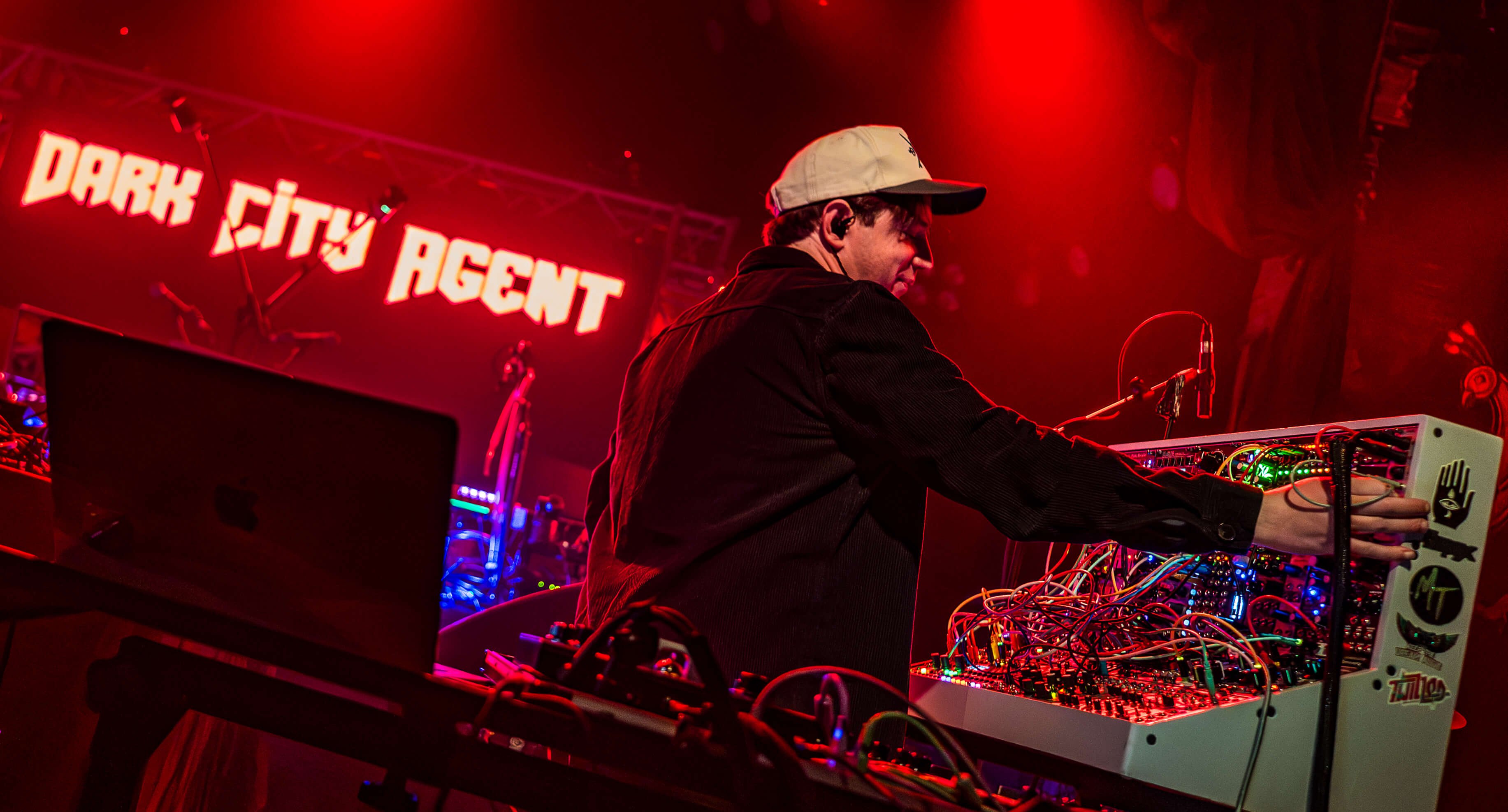
As the perpetually shifting music scene stretches beyond limitless horizons, Dark City Agent boldly breaks free of convention with his new genre-bending album, The Butterfly Effect, on Subwave Collective.
Robbie DelPrete of Dark City Agent is forging an electrifying musical identity and a mesmerizing artistic soundscape that is utterly unique and projected to soar to new heights. His electro-soul, bass-forward dance music fuses jam-band DNA and swirling psychedelic textures with livetronica’s long-form phrasing and clever sampling that pulls unexpected sources into the flow.
With pulsing dance-floor energy, introspective mid-tempo rhythms, and hip-hop influence, The Butterfly Effect is a cohesive body of work that captures Dark City Agent’s experiences and emotions over the past two years. Since our last chat with him here, on the single, each track on the LP was meticulously crafted and evolved through many live sets, hundreds of hours, blood, sweat, and tears, and life events.

Streaming over 5,000 listens in just under 24 hours, Dark City Agent organically pours out his soul and creativity with passion and intention in this full-length project. The artwork, done by Mandala Mind, gives the mind an intricate visual setting of luminous imagery and vibrant immersion, bringing us into the scenic soundscapes and visionary art of “the Butterfly Effect.”
“The title comes from the lead single, but the idea runs through the whole record. These songs grew up on stage. They were played live, reshaped by the shows, and carried onto bigger and bigger stages: from headlining R!AHT Fest in Aztec, NM with Mikey Thunder sitting in on turntables, to playing for thousands at Pretty Lights’ Yahn Dawn weekend at Meadow Creek. Most of them sound nothing like they did the first time they were played live” – Dark City Agent
Live, DelPrete is joined by Brittan Williams on keys and synths, who also helps shape the samples and setlists. The lighting designer, Pat Mainetti, runs the visuals. The music and visuals feed each other in the same loop, creating a magical A/V experience. They celebrated the album release live at Meow Wolf Convergence Station in Denver.
We sat down with the mind behind Dark City Agent to discuss “The Butterfly Effect,” his journey back into music after years away from the scene, and the philosophy that drives both his sound and his approach to building a fanbase.
Some May Ask, “Where Did Dark City Agent Come From?”
Well, he actually has been around for quite some time now. His undeniable talents earned him opening sets for industry leaders like Pretty Lights about ten years ago. He took a five-year hiatus to focus on his mental health and career as a software engineer.
Dark City Agent: A lot of people have asked me; they say, ‘These people came out of nowhere,’ and I’m just like, No. Back in Boston, I opened for Pretty Lights, Griz, Big Gigantic, and then I took 5 years off. I moved to Denver, COVID happened, and there were a lot of different directions I went in before figuring out what I really wanted to do.
I tried making jamtronica with a full band for a while, and then I just wanted to be able to show up to a gig with my USB and play. That didn’t last very long, because now we’re showing up with all these synthesizers, but that was the thought: I want it to be able to just play all my tracks without worrying about directing a band.

“I took five years and kind of really focused on my career so I could be stable in life, and then once I felt good about that, I could manage my day-to-day job and do music at the same time. So, I’m not coming out of nowhere. I’ve been doing this for a really long time.”
Dark City Agent’s choice to take time off and commit to his mental health reflects his dedication to authenticity and integrity. He expresses and releases his art in a way that feels genuine to him. So many artists lose sight of their artistic identity by rushing into projects, chasing trends, and pleasing algorithms. The progression of Dark City Agent shows the importance of staying true to your own values and vision, rather than conforming to expectations.
Dark City Agent: So one year ago, almost to the day, I played ‘Capital Confidential’ to two people. I just had, you know, a lot of experience from the first time around, and I thought to myself, be flexible. You’re starting from square one. Don’t let your ego get in the way. Don’t walk into the room and be like, you have to make me the headliner because I opened for Pretty Lights 10 years ago. No one cares. So that was kind of my approach: be humble, be flexible, be nice.”
I also realized back in the day, I was more focused on the scene and the industry. I would be like, oh, does this promoter know who we are? And then they would put us on. Like when opening for Big Gigantic at the House of Blues in Boston, you play the show for everybody, but did you really capitalize on it? Does anyone know who you are when they leave the room that night?
“The main piece of advice I would give artists trying to build a project is to focus on potential fans, not other producers, DJs or folks in the industry. It can be attractive to seek validation there and sure that support helps but you need to build a fan base above all else. Look to connect with people who like your music and your project!”

Dark City Agent: When I was rebuilding the project and playing for 10-15 people, I would go talk to every single person and give them a sticker. It felt like I wasn’t doing anything at the time, like I was just doing it to do it, but I feel like it comes back later. You have to really enjoy the music you’re playing, because if you love what you’re doing, and you get up in front of three people, you’ll be bopping around and having fun just because you’re getting to play your music on big speakers!
Liz, Electric Hawk: As the fourth Dark City Agent album, “The Butterfly Effect” is described as ‘meant to be experienced from start to finish.’ What was your process for ensuring the album flows cohesively rather than just a collection of tracks?
Dark City Agent: I had more songs than what I eventually put on the album, so I asked myself: what belongs, what doesn’t, and what fits the overall vibe? I made a list and kept adding to it. I wrote a lot of new songs in the last month or two before finishing the album. Once I knew the feel I wanted, I focused on writing and selecting tracks that matched that vision.”
The final production/mixing and mastering process took a very intense 3 weeks, where I stayed up till 3 in the morning working on it every other night. I had my checklist going throughout the process; I tried different orders, and I finally found one I really liked. My fiancée, Diana, actually helped me. I worked with a mastering engineer, and he did the final polish on the whole thing, but I did all the mixing myself and spent probably a hundred hours on it in the final month. It was a learning process – some of these songs I made two years ago, and I’ve been evolving them the entire time.
On the song’s evolution: we’ve been playing it live, but then for the album, I wanted to realize its true potential before it gets printed and sent out forever. I had to learn things along the way, where it was like, how do I make this particular sound that I want that I’ve never done before? I’m always experimenting, trying new things, and that was a big part of it. There’s this part on “Harley Slavidson” where the frequencies shift around in a really weird way. It took me about three hours to get that part right, but I did it.
That song changed a lot from the live version. At the 11th hour, I was really pushing myself to make it the best it could be. I would go on walks, and I would listen to the entire album. I wanted to put myself in that position and be like, how does this feel to me if I’m going on a hike or on a drive?
On the lead single “The Butterfly Effect,” the sample on it is a song by Roger Fakar called “My Baby”, She is Down as I Am who is the same artist Pretty Lights sampled on a Trip Through Time. Sometimes I’ll go look in the same places other people have looked, like Daily Bread or DJ Shadow. What artists do they sample? What’s adjacent to that? What is happening in this area?
I’m going to sound like Uncle Derek here (Pretty Lights), but I love recontextualizing old songs in a new way. Either in a new emotional way, with different elements that evoke different emotions from the original.
On Sampling Clearance:
Dark City Agent: I just feel like there has to be a better way for the industry to do this because I feel that it’s still art, and I put hundreds and hundreds and hundreds of hours into it, and then it can’t exist because I sampled something. It’s the old guard of the music industry versus the new. If I went and made a remix of “Eyes Cut Deeper” by Subtronics, Subtronics would probably be happy that I did that. If I wanna remix Frank Sinatra and Elvis, then that’s a problem.” “There is a license you can procure to release a cover song, why can’t the same thing exist for sampling?
On influences and identity:
Dark City Agent: Zed’s Dead is a huge influence of mine in terms of, not exactly the music, but how they’re their own genre in a way. They’re dubstep, but you know it’s them. I feel that way about, like, Justice, about Pretty Lights, about CloZee. Whereas you hear them from a mile away, and you know it’s them. That’s what I’m going for, too.
Liz: Do you have a specific example of how the live environment transformed a track?
Dark City Agent: We really had to put this to the test recently. After we played Yawn Dawn, we had new fans coming to our Meow Wolf show that had just discovered us two weeks later. So I felt obligated to give them a different experience, and it was also the same day our album came out. After Yahn Dawn, I sat down and produced 30 minutes of new music for this show, where it’s all remixed. That’s another thing that can be a challenge. You can’t go play the same show when you’re putting all the shows on YouTube.

Let’s take “Harley Slavidson,” for example. If you go back in the history of my SoundCloud and my Spotify releases, I released a version of it almost 2 years ago, and that was the original version. The drums are different. The production is different. It’s not as tight-sounding. When we started playing it live, I turned it into this ten-minute odyssey that has “Thriller” in it by Michael Jackson. When we were opening for Sugar Nova, I was like, let’s do a little nod to Lotus. We took a Lotus song in the same key and tempo, mashed it up with Nine Inch Nails’ “Closer,” and put it in the middle of the song instead of Michael Jackson. So it just started becoming where we’d have these middle sections to go in a different direction, do something different, and jam over it live.
“Ocean Pat,” for example, has a Bad Bunny sample in the live one we play. I knew that I couldn’t put Bad Bunny on the album, so I asked, what’s the point of this song? What’s the essence? I’m in these songs, changing them every show anyway, so I already am really familiar with them as pieces of music. A lot of people get attached to the first version of something they make, whereas if you’ve changed it 6 times over 2 years; when you get in to finish it for the album, you kinda understand it really well.
I don’t know if you noticed it, but there’s this little vocal that goes, “who’s there?” in that song, too and there is a story behind that – So I was in Mexico, and I went to this record shop, and I asked the record store owner to make me some recommendations – I told him what I liked, and he picked out a bunch of stuff and played it for me before I bought it. He played that one song with the “who’s there?” sample. And I was like, that’s such a good song; I love that, and I made it a point to sample that for the album.
Liz: What do you hope listeners take away after experiencing the album from start to finish?
For me, all the songs are from different periods of my life over the last 2 years. They became kind of like these anchor points or emotional support songs, and they reminded me of different things. Some of them feel almost alchemistic in a way. They feel like spells. This sounds crazy, but music is frequency, and they would pump me up; they would give me courage; they would give me what I needed at the time I made them, and I hope they can do that for anybody else who needs it.
I don’t feel like I’m the one who writes the songs. I go in there, maybe find some drum, make a drum beat that I like, and it reminds me of something else. No one goes in there picturing exactly what they want when they sit down to write a song. Producers in Nashville and Hollywood can probably do that, but for me, it’s a journey. Maybe the song is a journey, and I get invested in that journey. I also have autism and ADHD, so I think it’s therapy for me as well. My music attracts neurodivergent people. It’s like a neurodivergent siren or something.

On Recent Success and Taking a Break
Dark City Agent: As I’m producing music, it’s also like, how do you handle the attention? I swear to you, if this happened to me when I was 25, even this little success we’re getting right now, I would totally have crashed out. You’re gonna seize opportunities in front of you, even if they do seem crazy, but we’re just like, what’s our 5-year plan? Let’s be prepared for the best, and also expect the worst.”
I moved to Denver a week before COVID started, so I had a lot of intentions to make music again; I just got sucked into skiing and hiking and didn’t know a lot of people in Denver yet.
No one listened to my music for a really long time, but it feels like there was probably a reason for that. Like, everything happens the way it’s supposed to. I’m really happy with how everything’s happening. I also feel that it’s like, how much electricity can you conduct? Younger me couldn’t have dealt with this. I didn’t know I was autistic. I didn’t know I had ADHD. I’ve been in therapy for three years. I really believe that the universe doesn’t give you what you’re working towards or whatever you want, until you’re ready to receive it.
Inside the Tracks: Dark City Agent Reveals Stories Behind the Songs
The second track on the album, “Don’t You Really Wanna Know” feat. She Who Won’t Be Named, started as a question. The title sample taunts you: “Do you really actually want to know? What if the truth isn’t worth it? If we truly knew the answers to life, the universe and everything, would it change anything?” She Who Wont Be Named takes it somewhere personal, with lyrics about fame and being careful what you wish for: you may not actually want to know what that life is like.” – Dark City Agent
Denver-based rapper She Who Won’t Be Named wrote the lyrics for the full track in just a few hours. DelPrete recalls her as exceptionally talented and easygoing. After a Zoom call, she came into the studio, hummed along to the music, and quickly crafted lyrics that felt both meaningful and perfectly suited to the track. She also lends her voice to “Gucci Momma,” a song written by DelPrete.
At one point in the album, there’s a transition where the song “In My Mind” ends, and “Gucci Momma” immediately come in with vocals that sing “I’m going out of my mind.” There are many intentional easter eggs throughout “The Butterfly Effect” that you can pick up. They add to the storytelling and cinematic elements, strengthening the project’s cohesive journey.
DelPrete also made “Miracles” for his mom. On headphones in the same room while she watched TV, he built around a sample of one of her favorite songs: Jefferson Starship’s “Miracles.”
“She’s a force, one of the strongest people I know. To me the song is about believing in miracles and never giving up, which is something she taught me.” – Dark City Agent
In closing, DelPrete’s journey as Dark City Agent is a testament to resilience, reinvention, and the power of staying true to one’s creative vision. From humble beginnings and nights spent perfecting tracks to building authentic connections with fans and creating with friends, DelPrete has learned to trust the process. He embraces the unpredictable path of independent artistry and divine timing. His story resonates with anyone forging their own way in music or any passion.
The Butterfly Effect is a culmination of years of growth, introspection, and a refusal to let setbacks define the future. By blending genres, championing innovative approaches to sampling, and prioritizing real community over industry hype, DelPrete offers a refreshing blueprint for artistic success on his own terms.
As he looks ahead, DelPrete remains grounded in his passion for music and committed to evolving both on stage and in the studio. For listeners, his work invites them to find courage in vulnerability, joy in experimentation, and connection in the shared journey of sonic immersion and creative discovery.
STREAM THE BUTTERFLY EFFECT NOW
Tracklist
- Harley Slavidson 4:49
- Don’t You Really Wanna Know feat. She Who Won’t Be Named 3:40
- The Debt 5:08
- In My Mind 4:23
- Gucci Momma feat. She Who Won’t Be Named· Single 4:29
- Ocean Pat 4:28
- The Butterfly Effect· Single 4:17
- All My Tears feat. Kidkayd 33:45
- Miracles 5:10.
- Eclipse the Empire 4:06
- Tomorrow Never Comes feat. Mithridates 4:10
- Into Dust 4:07
- The Calvary feat. T the Wiser 3:15
- Big Wonder 3:56
Total 59:43
Keep up with Dark City Agent:
Spotify | Soundcloud | Instagram | Facebook | Youtube
Stay in touch with Electric Hawk & all our coverage
Twitter | Facebook | Instagram | Twitch | Podcast
And if you’re looking for new music, keep up with our weekly Spotify Playlist, Fresh Hunts, or follow us on Twitch. Whether it’s the newest drops from Dark City Agent, all your favorite artists, some old school, or underground—we just want you to hear it!


