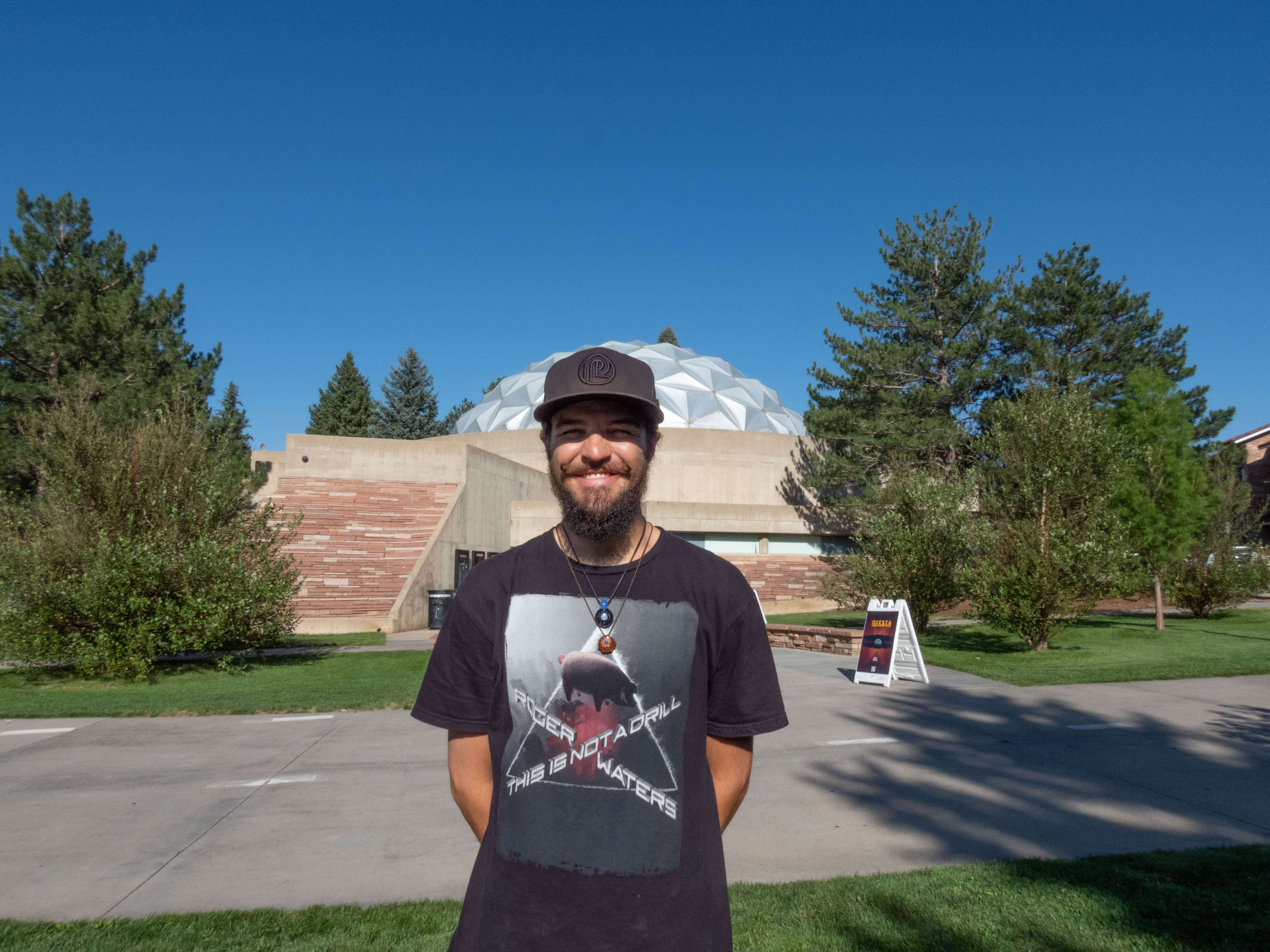
From navigating galaxy datasets inside a 360° planetarium dome to crafting reactive visuals for the stage, we introduce you to Floso. A Boulder-based visual artist, VJ, and laserist shaping immersive experiences at the intersection of science, art, and live music. His journey is as unconventional as it is inspiring.
In this conversation, he opens up about the path that pulled him from astronomy into performance, the power of live visual storytelling, and the creative spark that keeps pushing him forward, in an exclusive chat with Electric Hawk.

In Conversation with Floso Visuals
seradopa: Can you give a brief introduction to who you are to our community?
Floso Visuals: My name is Jeremy, though most people know me as Floso. I’m a visual artist, a VJ in the more traditional sense, and a laserist with Blue Brick Productions. I don’t really think in terms of “spare time” as none of us in this industry really have that. It’s more about the extra time you manage to find.
By day, I work at Fiske Planetarium in Boulder as an education project manager. I manage NASA grants and help produce films and educational resources on everything from exoplanets and transits to our sun and the broader solar system. I studied astronomy in college, and that passion has always been a constant in my life.
Part of my role at Fiske also brings my creative work into the fold. I help manage music programs and work as a laserist and visual artist there as well. Those intersections between science, art, and live experience are really what keep me going. I love the education side, working with school groups, talking about space, sharing that sense of discovery. I think that will always be part of me; I’ll probably be involved in astronomy education in some way forever.
At the same time, over the past few years, I’ve been leaning more into the entertainment side—and I’ve completely fallen head over heels for it.
seradopa: And you went to school at the University of Colorado – Boulder, right?
Floso Visuals: I studied astronomy and geology at the University of Colorado Boulder, though I didn’t start there. I came in as an aerospace engineering major, mostly because I was good at math and science, and people told me, “You should be an engineer.” So I figured, why not go all in and try to build rockets? It didn’t take long to realize that wasn’t for me.
At the time, I didn’t really know what I was going to do. Then one weekend, I went to a planetarium show, a Kid Cudi–inspired liquid sky visual experience, and it completely changed things. I noticed the person running it was a student, so afterward I asked how they got the job. They pointed me to the operations manager, and I showed up the next day.
He basically asked, “What can you do? Astronomy? Programming? Anything creative?” And I had to say no to all of it. But when he asked if I could sweep floors and scan tickets, I said yes! And that’s how I got my foot in the door. I started as an usher, just helping people find their seats, and from there I tried to get involved in anything I could. Little by little, I worked my way up, joining outreach trips and learning the ropes.
Around that time, I took a Stars and Galaxies class that really sealed it for me. The professor was this eccentric, Einstein-like figure who would start lectures by asking what we wanted to learn. Someone would say “black holes,” and he’d just go on these incredible, 45-minute tangents. I remember thinking, “You can do this for a living?” I switched my major to astronomy soon after.
From there, I kept building my skills at the planetarium. Learning how to present, how to run and program shows, and how to think visually. Then COVID hit, and everything moved online. I was managing the outreach program at the time, which used MilkDrop, an audio-reactive visualization system. I downloaded thousands of presets and just started experimenting in my room, listening to music, manipulating visuals, learning how to stay in sync, and mixing in real time.
That period of experimentation is really where it all started for me.
seradopa: What made you want to do it more and become a Visual Artist
Floso Visuals: I think I’ve always been drawn to shows and concerts that feel fully immersive. Where it’s not just an artist performing with some last-minute stock visuals thrown on a screen, but something more intentional. Early on, I noticed there were a few big names in the industry doing visuals in a way that truly complemented the music, enhancing it, shaping it, turning it into a full experience. That really stuck with me. It made me realize that when visuals are done right, you’re not just watching a performance, you’re part of something bigger.
I’d always loved going to shows, but there was this constant feeling of “I want to be part of this.” Not just in the crowd, but contributing to that shared experience, helping shape what everyone in the room is feeling.
That really started to take form during COVID, when I helped put together a streamed music festival with artists like Homemade Spaceship, Subb Spaced, Nyquist, and Deerskin. I had no real idea what I was doing. I was basically running astronomy software and layering visuals over it in real time. But it was my first real taste of live visual performance, and it completely lit something up for me.
What I fell in love with was the process of tuning into an artist, understanding their energy, their intention, and then translating that into visuals that amplify what they’re doing. It’s about creating a shared experience, something that pulls the audience deeper into the moment.
seradopa: Your visuals have a distinct feel. How would you describe your personal aesthetic in your own words?
Floso Visuals: If I had to sum it up, I’d say my work is all about blending science, nature, and art. Coming out of the planetarium world, much of my source material began with real astronomical data: galaxy maps, exoplanet datasets, and imagery of the universe. Early on, I was basically just throwing science at people, flying through that data, and presenting it in ways that felt visually engaging. People would say, “This looks incredible,” and I’d remind them, this isn’t just abstract visuals, it’s a map of the universe. Every point of light is an actual galaxy.
That foundation still shapes what I do. I’m also a photographer, and a lot of my current source material comes from astrophotography and experimental long exposures, capturing light in motion, often in ways that wouldn’t traditionally be considered “publishable.” I’m drawn to those imperfect or unexpected images, the ones that don’t seem usable at first, but can be transformed by flipping them, recoloring them, or layering them into something entirely new.
Nature plays a big role as well. I love capturing mountains, water, and clouds. Anything where light and motion can be stretched and reinterpreted. Then it becomes about blending those elements together into something more abstract and immersive.
There’s definitely a strong “spacey” thread running through everything I create, star fields, galaxies, nebulas, that sense of moving through space and time. And stylistically, I’m drawn to simple geometric manipulation. I love using mirrors. Flipping across axes, layering symmetry to build out intricate, almost kaleidoscopic patterns from very minimal starting points. It’s amazing how something simple can evolve into something complex and immersive with just a few transformations.

seradopa: I want you to go a little deeper on why science and space just draw you in.
Floso Visuals: That’s a great question!
Growing up, I felt pretty lost, especially in high school. I was always searching for some kind of purpose or meaning, and even going into college, I didn’t really have a clear direction. It wasn’t until I found astronomy, or maybe it found me, that things started to click. I like to think it was more the universe at work than anything I did.
What I realized along the way is that the most valuable thing I can offer someone isn’t just a collection of facts about how the universe works; it’s helping them learn how to think for themselves. There’s something powerful about seeing that moment when it clicks for someone, when the light bulb turns on. If you can give someone the tools to create or understand something on their own, there’s no telling where that might lead for them.
That’s really where my passion comes from: a love of sharing knowledge and experiences. Life can feel isolating in a lot of ways, and those moments of connection, when you’re learning from someone or teaching something new, carry a lot of weight. I try to stay open to that on both sides, always learning, always looking for opportunities to connect.
seradopa: How does it feel to incorporate a unique idea with the Fiske Planetarium and your artistry to a general audience?
Floso Visuals: Working at the planetarium is a really unique opportunity because it’s a fully immersive, 360-degree dome, completely different from how people usually experience visual content. Creating in that environment means you can build experiences that feel entirely new to an audience, and that’s incredibly rewarding.
A lot of the work I’ve been focusing on lately is leading live laser shows. We do a mix of improvisational, concert-style performances, where you’re triggering cues in real time, and more structured, time-coded shows that are carefully programmed to music. With those time-coded pieces, something interesting happens: I can’t hear those songs the same way again. The visuals become embedded in the music for me. They’re inseparable.
What really stays with me, though, is how people respond. When someone comes up after a show and points out a specific moment, something I did with a laser cue or a visual that matched the energy of a song, that connection means everything. It’s not just about what I create, it’s about what people experience and how they interpret it.
That’s the part that keeps me going. I love those post-show interactions, when people come up to the VJ booth or the laser operator or the sound team and just want to talk. It’s a reminder that this is live, human-made art, happening in real time, for and with an audience. Without that exchange, it would feel empty. But when people share how something moved them or stuck with them, it makes all of it feel worthwhile.

seradopa: Has there been a moment so far in your career, where you were like “Wow this is actually happening?”
Floso Visuals: In the past year, things have really started to feel real for me, but it didn’t happen overnight. I started taking photos around 2021, and around that same time, I was experimenting with visuals at the planetarium. It was fun, but it didn’t feel like something I could turn into a full-time path. The dome is a shared space: classes, research, and talks. So there wasn’t always room to fully explore or develop that side of things.
My first real step into the live music world came when a friend, All At Once, asked me to run visuals for his set at Black Box. I had just gotten an APC40 and honestly didn’t really know what I was doing. I showed up with my laptop, an external monitor, and way too many programs open: planetarium software, NestDrop, Resolume, and my photography, just trying to make it all work. But that night, something clicked. Experiencing visuals outside the dome, in a live venue with a crowd and music, it shifted everything. I remember thinking, “This is what I want to do.” I didn’t know how to get there, but I knew I had to keep going.
The real turning point, though, came a little later at a Pretty Lights weekend in Dillon. A group of us rented a house, and I brought a projector just to experiment, trying out projection mapping, seeing what I could create. At one point, Actualize walked in. Someone I really looked up to and I suddenly became very aware of how little I knew. When I finally worked up the nerve to talk to him, I was honest. I told him I was still learning and asked if he had any advice.
He said something simple but powerful: “If you don’t know what you’re doing, it’s not apparent. So whatever you’re doing. Keep doing it.”
That was the moment everything shifted. It made me realize that maybe I did have a place in this, that I could actually pursue it seriously. From there, I just dove in. Learning as much as I could, experimenting constantly, pushing myself to grow.
At the end of the day, it comes down to wanting to create with other creative people and contribute something meaningful, something that gives people an experience. If I can do that, even in a small way, that’s everything.
seradopa: Where do you see the future of visual art and VJing heading, especially with evolving technology?
Floso Visuals: That’s a great question! And it’s hard to answer it without talking about AI. I’ll be honest, I’ve had some resistance to it. I don’t currently use AI in my work, and part of that comes from not really connecting with the early styles I was seeing. It just didn’t resonate with me creatively.
That said, what people are doing with AI now is evolving really quickly. It’s starting to look more refined, more intentional, less like those endlessly morphing, abstract scenes and more like something you could imagine creating by hand. I’ve seen some really compelling uses of it, and it’s definitely made me more curious, even if I’m still a bit hesitant.
Where I really hope visual art continues to go is toward deeper integration with music and live performance. I’m already seeing that shift. People are starting to recognize VJs and lighting designers the same way they recognize artists. They’ll go to a show because they know who’s running visuals or lights, and I think that’s really exciting.
No matter what new tools or technologies come into play, I think the core will always be that human connection. There’s something you can’t replicate about someone running visuals live. Responding to the energy of the crowd, feeding off the moment. That’s where the magic happens. Those little, unexpected “happy accidents” you could never plan for in a studio environment, they only happen in that shared space.
I’d love to see things continue moving in that direction: more live, more reactive, more connected. I’m especially drawn to audio-reactive work, anything where the visuals are directly responding to what the artist is doing in real time. To me, that’s one of the most powerful ways to deepen the experience.
seradopa: Is there something you believe in our current music industry that could be improved in supporting visual artists and creatives in general?
Floso Visuals: Honestly, I have to give a lot of credit to what you all at Electric Hawk are doing. Just putting a spotlight on this side of the industry, helping people understand what goes into visuals, lasers, lighting – that’s huge. A lot of people at shows don’t necessarily think about it in the same way, or realize how much is happening behind the scenes in real time. But when you start to open that door and show that there’s someone actively performing at front of house, shaping the experience live, it changes how people see it. Suddenly, it’s not just the artist on stage, it’s a full, multi-layered performance.
I saw that shift really clearly at Cervantes last year with the VJ-led event curated by Actualize. He announced only the VJ lineup, no musical acts, and still sold out the show. That says a lot. It shows that when you put the focus on live visual art, people respond. They’re drawn to it.
I think that’s the direction things are moving, toward recognizing that this isn’t pre-packaged or secondary, it’s a live, creative performance in its own right. And when people understand that, they want to be part of it. I’m really excited to see more of that momentum build.
seradopa: As a creative, do you get distracted or are you ever hyperanalyzing what is going on on the screens?
Floso Visuals: One funny side effect of all this is that I can’t go to shows the same way anymore. At least a few times each night, I’ll catch myself just standing there, completely in my head, wondering how the lighting designer pulled something off, how the VJ is mixing, how those lasers are being built in real time. I’m constantly trying to reverse-engineer what I’m seeing.
But that curiosity is also one of the things I love most about this community. People are incredibly open and generous with their knowledge. I’ve found that just taking the time to walk up to front of house after a show, say “that was amazing,” and ask a few questions, people genuinely appreciate it. There’s a shared respect there, and a willingness to connect.
More than anything, I’m just in awe of the range of styles out there. Even when artists use the same tools, like Resolume, they approach it differently: different setups, different effects, different ways of thinking. It feels like there’s always something new to learn.
For me, that curiosity isn’t about copying anyone. It’s about understanding, exploring, and then finding my own path. What I’m really chasing is that moment when someone sees something I’ve created and thinks, “I’ve never seen that before—how did you do that?”
seradopa: What kinds of projects or collaborations are you most excited about right now?
Floso Visuals: I’ve got a few things in the works right now that I’m really excited about. I’ve been collaborating with SNDY and Buttonz on their upcoming EP. I first connected with them through the Keep the Dream Alive stream a couple of years ago, and since then, we’ve worked together on visuals for those events. Now I’m creating music videos and visualizers for each track on the EP, along with some promo content. That all drops in May, which I’m really looking forward to.
Another project coming up soon is at Dome Fest West at Fiske Planetarium. My friend Twizzled and I are putting together a 30-minute live laser performance to close out one of the nights. I wanted to bring more of a concert-style visual experience into the dome. Something that feels live and reactive rather than fully pre-programmed, so we decided to build it that way from the ground up. Twizzled will be performing a custom live set alongside it, which makes it even more special.
Beyond that, things are still taking shape, but it feels like everything is building momentum. With Blue Brick Productions, we’ve got a few upcoming laser projects in the pipeline, and overall it feels like things are starting to accelerate. I’m excited to see where it all goes this year.
seradopa: What advice would you give to aspiring visual artists trying to find their voice?
Floso Visuals: Don’t be afraid.
If you’re curious about something, follow that curiosity. A lot of the best things I’ve ever created, and some of the most meaningful experiences I’ve been part of, have come from what started as mistakes. You try something, it doesn’t work, you pivot, and suddenly something new opens up. That process is where the magic happens.
If I had to boil it down, there are a few things that really matter in this space: be kind, stay curious, and don’t let yourself believe you’re not good enough to try. That voice will show up – it definitely has for me. I’ve struggled with mental health and that feeling of “not enoughness” for a long time.
What’s made the difference is the support and curiosity of the people around me, and learning to accept that maybe I am capable. Once I started to believe that, even a little, things began to shift. That’s when the dream started to feel real.

Keep Up with Floso Visuals
Instagram | Facebook
Stay in touch with Electric Hawk & all our coverage
Twitter | Facebook | Instagram | Twitch | Radio Show
Looking for new music? Keep up with our weekly Spotify Playlist, Fresh Hunts. Updated every Friday with all the latest releases. Whether it’s the newest drops from all your favorite artists, some old-school, or underground…we just want you to hear it.